
Ouch. No, really.
Not turkey: A Thanksgiving expedition into the heart of human spiciness — Sichuan province itself.

NOTE: Twenty two years ago today, I took a Thanksgiving jaunt to Chengdu, in the heart of the province of Sichuan. My goal, for lack of a better way of putting it: to burn my face off.
CHENGDU, China, November 2003
I SUMMON THE WAITER with a wave and he rushes over, grinning, jabbering in Chinese about getting me whatever I need. It takes several seconds before doubt begins to cross his face, and this is why: I am trying to talk, but no words are coming out.
I am in a raucous room that opens onto a narrow, bustling alley. The place is called Yulin Chuanchuan Xiang — “Jade Forest Fragrant Skewers.” Its specialty is “firepot” - a brand of hotpot bubbling like the cauldron of one of Macbeth’s weird sisters, filled with some of the hottest peppers in the world. They float in the metal bowl in front of me, gastronomy’s answer to open canker sores.
Jade Forest is in an old neighborhood called Huaxing Jie, which in turn is in a city called Chengdu, which in turn is the capital of a western Chinese province that you may have heard of when you’ve ordered your takeout from the corner Chinese place. The province is called Sichuan, though you may know it as Szechuan.
This is the epicenter of spicy Chinese food and home of the “flower pepper,” a dried berry that, combined with conventional chili peppers, creates a tingly-spicy flavoring found in no other cuisines. I have come here looking for the hottest dish I can find.
I have been addicted to high levels of capsicum since I was a young boy living in Singapore. I had an amah — a nanny — named Amiah who cooked me Malay curry at age 6. The peppers, she would tell me, came from a crop that was also used to make muscle ointments like Bengay. So when it comes to spicy, I think I can take anything.
Which does not explain why, at this moment, I cannot speak.
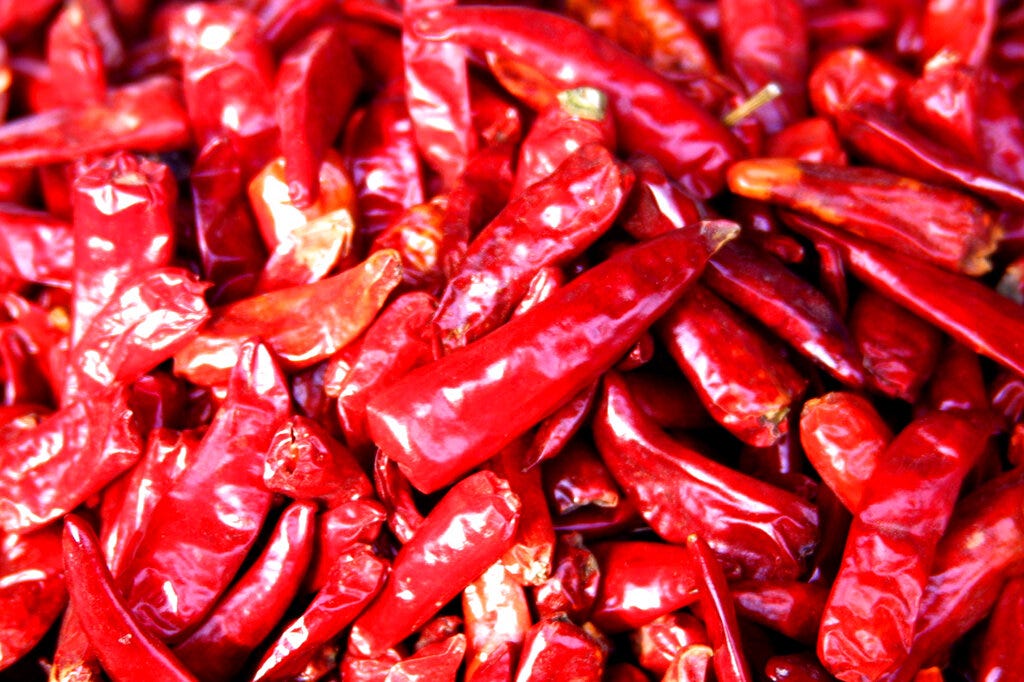
LANGUAGE ISN’T the problem. My Chinese, which I’ve known since I was 11 and living in Beijing, is just fine, thank you. It’s just that my throat and my lungs and my vocal cords are not cooperating. Beads of sweat are forming behind my eyebrows. I am the only foreigner within view. Everywhere, people are looking at me, pointing and shouting, “Laowai!” — “Foreigner!”
To my friends, the people I have briefed about this pepper-procuring vacation through a series of journal entries, I have dubbed my trip “Chasing Pain.”
It seems I have found it.
To Chinese people, hot peppers can be a defining topic. In all corners of the land, they say to each other, “Ni chi la ma?” -”Do you eat spicy?” There’s no shame in saying you can’t — the Cantonese are proud that they don’t chi la —but there’s a certain hardy, roll-up-your-sleeves manliness to answering the question in the affirmative.
That is not why I’m here. I have come to Chengdu on a personal mission.
I have craved spicy food for most of my life. I collect hot sauces from all over. I have yet to meet a “Suicide Wing” that can intimidate me. In college, my fraternity brothers paid me $10 a head to do — wait for it — shots of Tabasco. They considered me a carnival attraction; I walked away with a weekend’s worth of beer money.
Ergo, because I add hot sauce to everything, I figure I should visit a place where I don’t have to.
Sichuan food is really nothing like Szechuan food, its American counterpart. Once I was in a Chinese restaurant in a large northeastern U.S. city that rhymes with “Chew Pork” when a woman at the next table bleated to her companion, “Szechuan means SPICY in Chinese.” Well, no, actually Sichuan means four rivers, and even that’s metaphorical. And anyway, her food wasn’t spicy; the manager of that particular American-Chinese Sichuan restaurant was Taiwanese, which is as if a North Carolina barbecue pitmaster opened a New England clam shack in Minsk.
Even back in Beijing, where the greasy Sichuan eateries are plentiful, I kept hearing whispers of a better place, a magical realm out west where the tongue-tingling peppercorns were even more plentiful and the red peppers were utterly relentless. I realized that if I truly wanted to burn my aforementioned face off, I couldn’t do it remotely. So I set out for Chengdu.
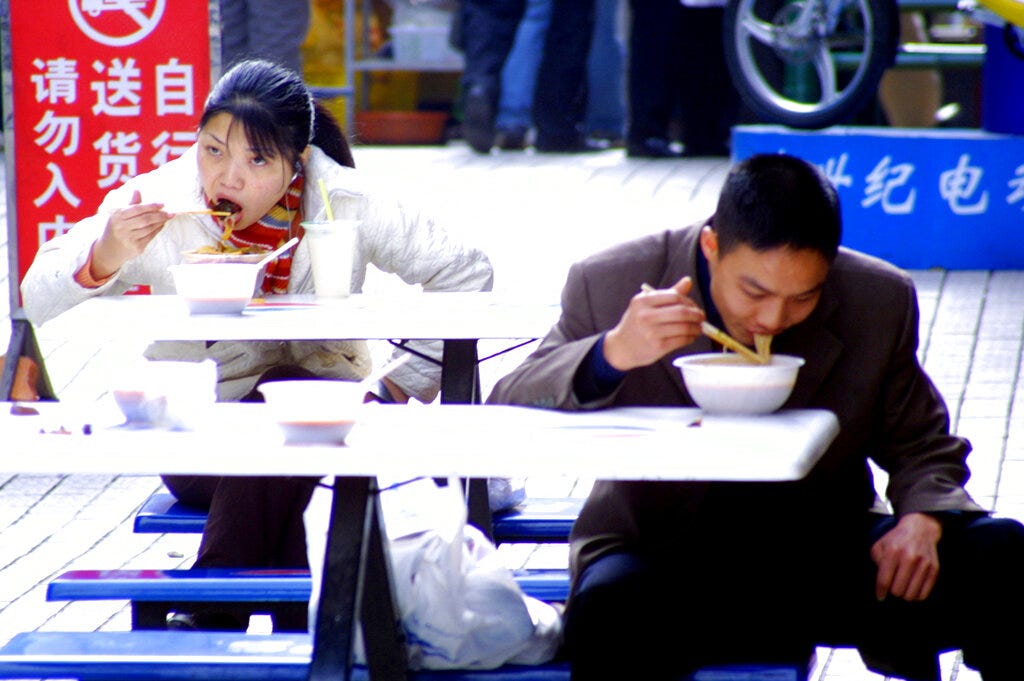
The city is famous for its xiaochi, or “little eats” — more than snacks, less than meals. The country is dotted with “Chengdu Little Eats” — places where you can get a bowl of spicy pork, tingly dandan noodles or the town specialty, scarlet-sauced spicy “pockmarked” tofu with minced beef. Firepot, with its endless skewers of sundry vegetables and meats, is part of this category.
I spend my first few days making stomach sorties from my hotel, first within a two-block radius, then a mile, before I cast a wider net. Each place is more delicious than the last. At one ratty snack place, the red-oil dumplings send me into fits of orgiastic moaning. People stare, and, like many of the times when they see my white face and hulking frame, there comes the inevitable shout, friendly but pointed: “Laowai!” At 10 p.m. each night, I waddle back to the hotel and sleep fitfully, dreaming of my next meal.
It’s an odd experience doing all of this solo, because eating is such a communal event to Chinese people. Until fast food arrived, it was unusual to have two-person tables in any restaurant. Perhaps the best-case scenario would have been for me to bring along my posse (presuming that I had a posse) so that many dishes could be sampled.
Yet this particular search seems better conducted in solitude. It’s a bit obsessive, and obsession is better parsed in private. Plus, the dramaturge in me enjoys the notion that This Is A Quest I Must Complete Alone. And on a more practical level, between the peppercorns and ginger and pore-infiltrating garlic, I’m not the most fragrant person to be near. Or, depending on your perspective, perhaps I am.
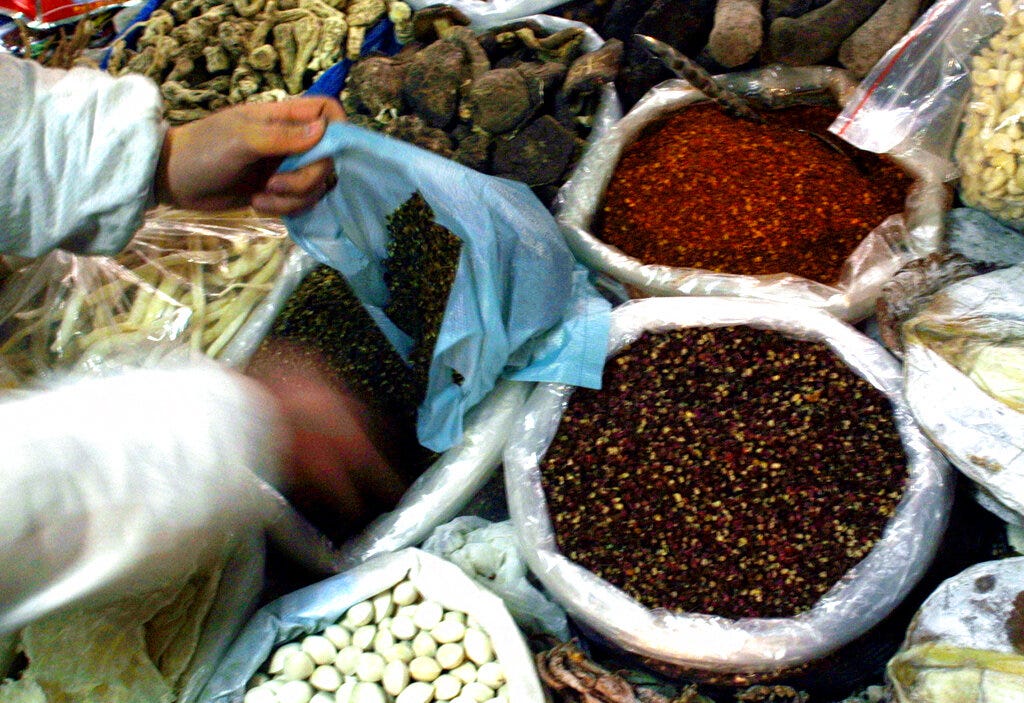
One morning, I visit a wholesale market and buy a pound of flower peppers (花椒) to take back to Beijing. I ask at one of the stalls where I can find the hottest hot sauce around. The woman points me upstairs; as I walk away, I hear her laughing amiably with her stall mate.
“Laowai — always interesting,” they say, giggling as I turn around to give them a good-natured glare.
THE WAITER is still waiting for me to say something. But I can’t.
I am huffing. I am Lou Costello desperately trying to tell Bud Abbott that some rampaging creature who looks a great deal like Lon Chaney Jr. is approaching. I try again; nothing but air. He grins. He thinks I am in pain when I have merely succumbed to pepper-induced laryngitis. I look into the firepot, and peppers specially selected because of their personal dislike for me glare back up.
Around me, in every direction, Chinese are dipping pieces of vegetables, meat and things I don’t begin to recognize into vast bubbling cauldrons. Gomez Addams would have enjoyed pouring this concoction from his roof onto Christmas carolers.
Imagine the possibilities for medieval castle defense: A moat filled with boiling, blinding Sichuan red oil would have made the ideal holiday accessory for that hard-to-please viscount. And what about Sichuan Pepper Spray for warding off assailants? Its time hasn’t yet come, but you can bet Williams-Sonoma or The Sharper Image is keen to get it into R&D.
I gulp and remind myself that Deng Xiaoping, the leader who started China’s economic reform, was Sichuanese. He was a tiny man — sometimes called “little bottle” — and if he could take it, I can.
Finally, after about 30 seconds, speech returns.
“Bottle of beer,” I wheeze in Chinese. The waiter runs and returns with the first of two malt-liquor-sized bottles of Golden Blue Sword, a thin, tepid brew that quickly becomes the most refreshing thing I have ever sampled.
Half an hour and 30 skewers later, the phlegm in my respiratory tract is looser than a 7-year-old’s baby tooth. I ask for the check (about $6.50), and the busboy stares at the empty plates. “Most foreigners who come here, they can’t take this or don’t like it,” he says. Not a compliment, but I think he vaguely approves.
My esophagus throbs. I wander out into the narrow street and inhale deeply, hungry for non-peppery air. From behind me, I hear someone shout. “Laowai zou le!”
The foreigner has left the building.
Ted, Ted, Ted. I (who find so many foods too spicy) have no words. Not because of a blistering, burning throat, but because this essay is so Ted. I hope you will be enjoying a nice non-spicy turkey tomorrow like a normal person. (Somehow, I doubt it.)